An email I got from Steve Shoemaker:
Cameron,
My wife and daughter just got back from Haiti and  they helped deliver one of two of the sewing machines that Dan Pace delivered from our church to a church in Pignon. The other sewing machine had already been delivered to some grateful Haitian women.
The pictures show Daniel Pace’s Cirrus  that volunteered to fly the machine from Ft Lauderdale to Pignon, Haiti.  The picture is on the ground in Pignon (grass strip airport).
Being off loaded, put back together, crossing over rivers to get to it’s final destination, our teen team surrounding the machine in back of the pickup truck and carrying
it into the little church that it will be used in for the community.  The final picture shows it set up, threaded and ready to go.  It will join another machine that is already
there.  There was a room filled with women in line to use the machine when we got there.  That little machine just thought it had seen the end of its usefulness, but it is
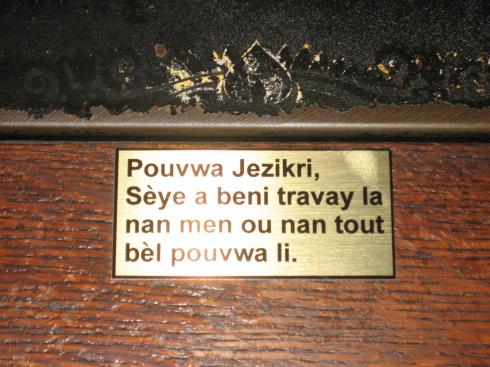
now in a new home (thanks to the generosity of a woman in Lexington, Ky,Bahamas Habitat and Dan Pace) and ready to serve a new community for years to come.   My wife had a little plate made for the machine which said:
“May the Lord Jesus Christ bless the work of your hands to His glory”.

This slideshow requires JavaScript.

IMG_7623

“May the Lord Jesus Christ bless the work of your hands to His glory”

May God bless you with discomfort
At easy answers, half truths, and superficial relationships,
So that you may live deep within your heart.
May God bless you with anger
At injustice, oppression and exploitation of people,
So that you may work for justice, freedom and peace.
May God bless you with tears
To shed for those who suffer pain, rejection, hunger and war,
So that you may reach out your hand to comfort them and to turn their pain to joy.
And may God bless you with enough foolishness
To believe that you can make a difference in the world,
So that you can do what others claim cannot be done,
To bring  justice and kindness to all our children and the poor.
Amen.

Met a girl last week in Haiti.  She is about five years old and gets to live in a home for children with special needs after she was found abandoned and starved in a building.  When I saw her she was stonefaced.  Then someone that she knew waved and her face lit up with the widest smile.  Her condition is that the only emotion she knows, and ever will feel, is happiness.  Reninca, an English missionary, who lives at the home says that the girl would have died of starvation and never felt the agony or sadness.  I wondered about her if it is so much of a ‘condition’, or a blessing.

A couple weeks ago we flew to Haiti in a company of two – the Baron N74EM and volunteer pilots Chad and Angela Johnson flying their C210 N37DP.  DP flew Cowboy and water systems and EM flew Charles Stites and Jeremy Maddox of Able Flight.  The plan for the week was to give Cowboy an opportunity to recover from nearly two years of water system installations in Haiti since the earthquake by cleaning up systems and following up with previously installed systems.  Able Flight, a US organization devoted to providing scholarships and training to those with physical disabilities, planned to meet with Haiti Hospital Appeal who focuses particularly on patients with physical disabilities in Haiti. A special effort HHA makes is training and sponsoring paralympic teams from Haiti to represent the country in the worldwide games.  It’s incredible.  Charles and Jeremy got to spend the week with those at the hospital and did everything from racing the racing hand bikes, talking about training techniques and culminated to our last day when we got to take six patients up for local flights.  It was really beautiful.  It went seamlessly and was a great day for everyone.

The little girl I saw left such an impression on my heart that I wondered about the happiness we all felt when we got to go up in the planes, a special moment for anyone, not only someone who’s physically disabled in an impoverished country.  It was euphoric even.  Even with that feeling you still see the effects of poverty that has so many levels of tragedy.  It would be so much easier to only feel happiness but what I’ve been seeing is when we see realities we cannot begin to be connect to one another unless we feel, and feel deeply.  Rejoice with those who rejoice, weep with those who weep. (Bible, Romans 12:15) It is a rhythm to which we realize love.

peace.

*Pictures will soon reach

No need to mince words.

Cite Soleil is a dump. A pigsty. Footing is rancid muck at neap tide, and liquifacted bilge at the perigee. The stench will do for your appetite. Pigs thrive, but people look transient, the kids in tattered shirts, excoriated skin eruptions. 

The ramshackle structures had one advantage. Nothing much was lost in the eathhquake.

It’s a notoriously lawless place, violent, run by various thug outfits. There’s disproportionate mayhem, and the police don’t care to go in after dark. Women are at risk.

Open cook fires result in horrific burns, which fester untreated.

The hind end of it, on the bay, under the middle marker for the ILS for runway 10 (what the hell- add jet noise to the mix), is called derriere chabon, behind the charcoal.

The place is just chaos, entropy’s bitter end.

In Rick Freschette’s words, a fixer-upper.

He doesn’t seem to think like the rest of us.

Lives in hand, we took a mototaxi down to see what he’s doing down there.

He went down to confer with the gangsters he hired at shop rates to build his primary care clinic and hospital. The plan is to treat basic problems  here, and refer the sickest ones to St Luc’s. A standard hub and spoke system- it works better for medical care than air travel. 

He opened an internet cafe there, too, but it’s been slow going- the net company stiffed him, or at least didn’t fulfill the terms of the contract. Just advancing the concept surprised me- no water, no electricity, no solid structures:

Rick, what the hell are you doing setting up an internet cafe?

Well, how are they going to participate in the modern world, look at Craig’s list, submit a resume, get a job without net access?

Rick, they don’t even have pants.

Right, they’ll need to get those, too. Make a list.

A tough guy to argue with.

First, he  got it off the ground- literally. All that rubble in downtown Port? Just scooped it up, and lay it in Cite Soliel, and built on it. Dry feet.

The hospital will be pretty nice- open wards with enclosed bathrooms in the back, 

a throughway in the front, like the cholera hospital layout.

He used the gangsters to build the hospital and the adjacent residences. They’re not bad as builders, and the result compares well to the surround. They seem proud of it.


He visits them daily, talks things over (and counts the silverware, I suspect). It’s a vigorous discussion.

They come to some agreement, everybody representing. They connect with him.

Later, he wants to power it with solar panels (possible), truck in water (expensive) or build a water tower (very expensive), and lay out septic lines (Nah. This place couldn’t pass a perc test at gunpoint) or collect the honey pots with a very expensive truck.

Honey pots- what, they called in George Orwell to head up the department of obfuscatory monikers?

But you get the idea. 

Start with a completely naive assumption.

Everybody everywhere deserves a little dignity, something clean and decent in their lives- regardless of the setting.

Then pretend everything is normal, and try to make it so. 

In just a short time, this leads to surprising ideas.

I spent most of my time looking down, at the pigs and the filthy kids, at the amazing cluster of garbage and detritus at the water’s edge.

That’s a doctor’s view, I think- feet of clay. I looked at the bottom of this next picture, and asked why? Rick looked at the top half and asked why not? 

That’s what faith will do for you.

But when I looked up and squinted a bit- a process made easier by my lack of wraparound shades, which would have kept perilous quantities of grit and road dust out of my conjunctivae- when I looked up and squinted, I could sort of see what he was talking about.  

Dr. Mac is in Haiti this week.  This is his latest:

“Cholera arrived in Haiti last October 12th, the runoff from the Nepalese UN camp fouling the Artibonite River, flowing downstream to St Marc’s in the central plateau, and then it was Katie bar the door. Initially, the treatment was chaotic, and widespread panic wasn’t just a doper’s band. The morgues filled way beyond capacity, people were afraid to bury their dead, and riots closed Cap Haitien. Many doctors and hospitals opted out. The great flood of earthquake sympathy and earthquake dollars dwindled to a trickle, more easily stanched than the disease. Before long, that river ran dry. The UN is still here in force, but NGOs squabble over ever smaller biscuits.
 Sewage treatment, the grand grotesquerie underpinning all modern civilization, is unknown in Haiti, where roadside gutters are a stinking disgrace. The disease is on board for my lifetime, at a minimum.
 St Damien’s, a high quality pediatric hospital, grew new divisions- I washed up at St Luc’s, which didn’t even exist before the quake, and mostly worked St Philomene’s, the cholera hospital, which of course was also brand new- both a couple hundred beds now, full fledged institutions.
 We got good at it. Eventually, things settled down. Severity was ranked A,B and C- the treatment became algorithmic, a nurse’s checklist. Now they just call when they bleed or have fever, TB or HIV, or something besides. Over the summer, the numbers declined.
Lately, the rains have been intense, unseasonal. It’s coming back with a vengeance.

But first, let’s do the numbers.

20,000 patients came through St Luc’s this year. Some, “A” patients, where treatable with ORS alone. “B” and “C” patients also required Lactated Ringer’s, at $2.50 a bag, and an IV, or more likely 3-4 IV’s over 3-4 days, at a dollar fifty a pop. The NG tubes were free, since I stole them, but the intraosseous lines were high at $25 bucks each. Some of the C patients required 25 bags the first day-  the fluid shifts amaze me still. Combining all, each cholera patient averaged 20 bags of Ringer’s.

We poured it in, and they poured it out, down the drain.

It was hot, so we ran some fans. We fed some families, mostly MREs, but beans and rice, too- had to buy that.

All in, a million 5.

A coupla FIKI Cirrus.

A large load carried cheap, if you ask me.

But they don’t. At least, they don’t ask about that.

Haiti’s too depressing, too close to home, a failure in too many ways. You can’t look at it hard without feeling worse about yourself, all of us, about humanity.

We should blame them.

So when people ask “Is anything really getting better down there? Where did all that earthquake money go?” They don’t really want details.

They want confirmation of widespread corruption.

They want absolution- forgiveness- what we all want, in case we skip an important moral step as we cruise through our blessedly sunny lives, at a safe altitude, our heading on autopilot.

In case our way of life is somehow integrally related to this penury.

In case this Jungian sense of connection, always felt, and reinforced by the net and global smalling, is real, and we really are meant to be our brother’s keepers.

But Hell, I like people.

I skip moral steps all the time- and never more than since I started coming to Haiti, for some reason.

So I let them off the hook.

I tell them I think it all went down the drain.

Quite a bit of it did.”

As a continuation of the relief efforts to rebuild Cat Island after Hurricane Irene swept it pretty strong, Bahamas Methodist Habitat (BMH) has since coordinated a rotation of local volunteers to utilize the supplies purchased by the Bahamian government to rebuild the roofs for Cat Island.  It really is incredible to see so evidently the positive impact when many people contribute towards a common purpose.  What we got to do this past weekend is a prime example of the difference that general aviation makes when those of us in the States see it as a luxury, it is realized to be incredibly beneficial to those in the islands disconnected from many resources.

Thursday we flew from Orlando in the Aztec to Nassau where Todd Ruopp and Katharine Zimmerman got to partner with the Bahamas Conference of the Methodist Church (BCMC) in strategic development, then flew to Eleuthera to drop off our load of building materials for BMH and paint for the Zion Children’s Home, where we were then met by three volunteers who we got to fly to Cat Island and back to Eleuthera for the night.  That was Thursday.  The reality is that with Cat Island being literally 52nm from Eleuthera, the flight time in the Aztec at 160 TAS is 25 minutes.  Without a plane like the Aztec or a personal boat, you have to rely on the commercial airlines which means going from Eleuthera to Nassau to Cat and round back around.  Takes nearly a full day.

Sarah Stewart has been involved with BMH for the last couple years and since graduating from UNC-Chapel Hill continued her involvement with Young Life, a US-based Christian ministry with the vision that every adolescent will have the opportunity to meet Jesus Christ and follow Him.  Sarah plans to move to Eleuthera in January for three years to establish a presence through Young Life to engage the youth on the island.  Friday we got to meet two representatives from Young Life as they were getting acquainted with the island and envisioning Sarah’s ministry on Eleuthera.  I’m very thankful for their efforts and intentions there and excited to see what all they get to do in the next three years.

Sunday we reversed the Eleuthera – Cat Island Shuttle getting to utilize the empty legs to Cat to transport more supplies for the roof rebuilding.  We transported nine volunteers in the morning before flying to Nassau to carry the Young Life representatives and pick up Katharine and Todd.  The eleven volunteers on Cat from Thursday evening to Sunday morning put on NINE roofs!  That’s almost one per volunteer and nine homes that wouldn’t had a roof that soon, if at all in the near future, had it not been for this team.


Rolls of felt paper for the roofs with Julian, Kennedy and Kendrick – 3/11 volunteers

It was productive and really saw the usefulness of the plane.  This Aztec is a F model with long-range tanks.  I was amazed that we flew from Orlando – Nassau (took on 20 gal) – Eleuthera – Cat – North Eleuthera without worrying about fuel quantity.  It flew 3 roundtrips from Eleuthera – Cat islandThe fun thing is to imagine if we had more pilots and planes – we could have done it more quickly and possibly transported more supplies!

Last weekend Neil Glazer, PilotMall.com, and I took off from Albert Whited Airport in St. Pete, Fl. bound for Haiti.  We were completely loaded with a couple baby swings, baby food, paper to make jewelry, all for an orphanage in Port au Prince.  Stopped for fuel in Great Exuma and landed in Port to clear Customs and drop off the load then up to Cap Haitian where we met the Haiti Village Health crew: Santo, Dr. Tiffany and Emmanuel.  We stayed with a British Baptist mission who focuses on a local hospital.  It was beautiful all the different people who collided:

-Notice that the backdrop of the picture is a shipping container converted into the office at the hospital. Sustainability rocks.-

Originally our plan for the week was to drop the load as we did, fly to Cap and meet up with the crew you see in the picture and we did that too, take two of them to Jeremie, Haiti for a health conference for 3 days, back to Port and then to the States.  The plan shifted at the Jeremie part as Dr. Tiffany had her bag stolen with her passport in it the night before we landed.  The next day we took her to Port from Cap so she could get her passport straight.  The conference was no more and we realized that there wasn’t a need for us any more.  TIH (This Is Haiti).  For the delivery of the orphanage’s supplies and being there for HVH, it was really productive especially with all the dynamics that always happen.

Port au Prince

Haitian breakfast is honestly delicious

“Mozzi Nets”

Saw 2/3 MFI DC3s in Cap Haitian – not an everyday sight

Village in the mud on right turnout from Cap, see them everytime

Haiti is really beautiful

Royal Caribbean thinks so too, on the other side of the mountain from the mud slum.  Economy, right?

Haiti Village Health‘s site, Bas Limbe.

In light of the Hurricane Irene relief efforts, we decided our time and resources would be better suited in the Bahamas.  Tuesday we flew to Governor’s Harbour and met BMH and settled in for the rest of the week.

The Bahamas are beautiful too

Cupid’s Cay of Governor’s Harbour, Eleuthera

James Cistern, Eleuthera (see all the tarps?)

We went to Cat Island to assess for week-long rotations of local volunteers from Eleuthera.  There we found a lot that needs to be done with many willing people.  The team of 10 from Eleuthera will be cleaning up and putting on roofs with supplies bought by the Bahamian government.  It will be a long, long road.  On the way back to Eleuthera, we stopped at Staniel Cay and of course had to go see the swimming pigs.

Staniel Cay swimming pigs

Learned the history that these pigs got put here by the pirates so that they would have food when they were sailing around the islands.  These pigs are ridiculous.  They’re like pirates themselves trying to get in the boat:

Everyone should go see these things.  I can’t stop laughing when I see them – mostly because I’m scared of them.

Neil made a run to Cat Island when another volunteer pilot, Ed Lippisch, flew supplies from Daytona Beach to Eleuthera and it was a big help too:

The next day we took off back for the States and Neil and I went back to where we are from.  I loved getting to spend time with our family in the Bahamas and Haiti both.  The hurricane relief effort will continue for a long while still and we are thankful for the local volunteers willing to go to the different islands for the rebuilding.  Thankful to Neil as well for his generosity and willingness to serve.

peace.

Disaster response is in three phases: Response, Relief, Recovery.  The part that gets the AOPA articles and the intense focus and attention is the romantic part – Response.  It is an adrenaline rush, no doubt, and you see immediate results – a weakness for all us as humans.  When the we closed the airlift it was a result of the realization that supplies were being stockpiled, we saw the regular DC3 making it’s route through the Bahamas and Haiti, boats left the docks and people were ‘okay’.  ’Okay’ doesn’t imply stability – it means the bleeding has stopped and we’ve come up for air looking to see where we will continue rebuilding.  Ideally, the response effort lays the foundation strong for sound rebuilding and we all come out of the disaster for the better.  This is the moment where we are now.  The tarps will wear out soon and hurricane season doesn’t end until November 15th.  Long term development this time will start with rebuilding roofs.  A few things that never get mentioned in the chaos of the obvious: 1.) Disasters smell bad, serious stinch.  In Haiti the smell was atrocious with no sewage system, bodies everywhere, lots of unmentionables.  In the Bahamas with the storm surge beaching fish and seaweed and the sun coming out and flooding – it wreaked of mildew and dead fish.  2.) The emotional disaster that events like these cause.  For example, in Haiti many of us who did not experience the earthquake first hand and remember the feeling of being there want to rebuild houses immediately.  Instead, many went to live in tents as the reason they were still alive was because they happened to not be in the houses that were built like the ones the rebuilders were pushing.  That is why more than a year and a half later, you still see tent cities thriving to the extent of planting gardens around these tent homes.  The emotional and psychological impacts are rarely paid any attention.  In the Bahamas with this clean up effort, we have to remember that hurricane season is only a little more than halfway through.  So at the airport, you will probably see the windows boarded up for awhile.  This verse from the Bible became very real to me through the time and effort lately:

If one member suffers,

all suffer together;

If one member is honored,

all rejoice together.

-1 Corinthians 12:22

Love is a rhythm to the beat of this verse’s truth.  Love is bearing one another’s burdens.  It’s also rejoicing in times that are good.  Thankfully with God, not implying rainbows and sunshine, all is well always because we get to claim reconciliation and redemption amongst chaos and disaster.  So we celebrate that.

Yesterday is gone,

Tomorrow has not yet begun,

We have only today so let us begin.

-Momma T

peace.

Jon Short and Cowboy
Jon Short (far right) and Cowboy to his immediate left prepare to head out with the team.

After an early departure from Cullman, Ala., at 1:45 a.m. Central time Aug. 30, Jon Short, Cowboy (Brian Ferguson), and his crew rolled into Fort Lauderdale Executive Airport around 7 a.m. to be part of the Bahamas Habitat fly-out to different islands in the Bahamas. Cowboy and two volunteers will be working on Cat Island for a week, and Short is ferrying supplies in his Aztec. He flew several missions on Tuesday before clearing U.S. Customs about 7 p.m. in Fort Lauderdale. But that still wasn’t the end of his day, which was already pushing 16 hours. He had to get reloaded with supplies for Wednesday. (His mission isn’t scheduled for 1:45 a.m., so maybe he’ll catch a few extra winks.)

By mid-morning Tuesday, Cowboy and his two volunteers had already assessed many of the needs on Cat Island. We met up with them after clearing Bahamian customs on Great Exuma Island, which seemed to weather the storm with mainly damage to trees.

Damage on Cat Island.

Cat Island, and particularly the Orange Creek area of the island, was hit hard. Much of the fencing in front of the FBO at Arthur’s Town Airport on the island was leveled. But that was minor. In some places, asphalt was washed off the roads like sheets of tar paper. Trees were twisted, and power lines were in the streets. Hurricane Irene’s storm surge washed through the back of one woman’s house, pushing her refrigerator out the front and across the street. Everything two feet and lower was ruined. She plans to move her furniture outside to let it dry. Cowboy said one of his team’s goals will be to help disinfect her house to prevent mold.

Annie Burrows, a janitor at the FBO at Arthur’s Town Airport, has been cleaning the airport facility and helping move relief supplies that are being flown in by Bahamas Habitat. She’s putting her needs last. Her house is still standing, but she lost everything. “I lay on the floor and keep the door open,” she says of living at home now. The water ruined her mattress and the lack of electricity makes being inside without a fan unbearable. Residents in Orange Creek should get power later this week or early next week, one local estimates.

Unloading supplies on Cat Island.

After unloading half of the supplies from a Baron and Aztec at Cat Island (and stacking them in a truck and van, unloading the van where supplies will be sorted, and then reloading the van from another aircraft that had flown in), we wish Cowboy and his crew luck with the big task ahead and head to our next destination. We survey Long Island from the air and then fly to Governors Harbour on Eleuthera Island where Bahamas Habitat has a base camp.

A Piper PA-23-250 at Governors Harbour International Airport was ripped to shreds. The tiedown, chalks, and three 100-lb sandbags that were meant to hold it in place were still in their places. The aircraft, however, had flipped over the airport’s perimeter fence, both engines torn from the aircraft, and the fuselage cut in half behind the baggage door.

Twin destroyed by Irene at Governors Harbour.

We should have known that would foretell the destruction we would soon see.

Bahamas Methodist Habitat Executive Director Abraham McIntyre and Rev. Kenya Lovell, minister for the Central Eleutheran Region of the Bahamas Conference of the Methodist Church, brought us to Cupid’s Cay near the airport while they continued to survey damage, assess needs, and hand out tarps. Trees, mattresses, and appliances were piled in between houses along the one-lane roads. A family worked to erect one side of a room that had collapsed. Another man sat on a downed telephone pole, his head down as he rested his elbows on his knees. But he paused for only a moment before getting back to work.

That’s how resilient all of the Bahamians have seemed on this trip.

Diana Demeritte

Even Diana Demeritte, whose husband of seven years died in March and whose house was almost completely destroyed by Irene, is picking up and moving forward. She’s cleaning out her house, surviving with a makeshift plywood roof and a tarp, two gallons of clean water, and some nonperishable food. Amid the cleanup and heartbreak, she takes some time for herself—coloring her hair.

John Gaitor’s house was farther inland than Demeritte’s, but the shingles on his roof lifted, allowing the hurricane’s rains to flood several rooms. Sometimes he needs a little motivation to continue the cleanup effort after a long day at work with Bahamas customs. Without any electricity, he gets a little creative. One evening, he turned on his car radio. Music streaming from the car put him and his neighbors in cleanup mode. “It keeps that community spirit,” Gaitor says of joking with friends and playing music.

The Bahamians are taking Hurricane Irene’s destructive path in stride, but they still need help—especially those in underserved areas far from the resort towns. Many of the docks on the islands were damaged, making it difficult for ships to deliver supplies. General aviation has played a key role in getting food, drinking water, and tarps to the Bahamians quickly. And with the long days of logistics calculations and flight time, these pilots and volunteers seem as resilient as those they are serving. In just a few hours, they’ll be at it again. Nine flight activities are scheduled to various islands on Wednesday, as half a dozen pilots or more are volunteering to help. Another 1,000 pounds of supplies will be dropped off at Fort Lauderdale Executive to be delivered. Short will be flying around the islands delivering food and water, and Cowboy is scheduled to get some much-needed roofing supplies on Cat Island.

http://blog.aopa.org/blog/?p=2188

Past Posts

Enter your email address to subscribe to this blog and receive notifications of new posts by email.

Join 23 other followers

Follow

Get every new post delivered to your Inbox.